How an Annual Neighborhood Day Becomes a Local Custom
An annual neighborhood day becomes a local custom through familiar rituals and flexible participation, giving residents a reason to gather without fixing every detail.
How does an annual neighborhood day become a local custom? Usually, not through a grand plan. It happens when residents repeat a few meaningful choices, adjust what does not fit, and remember why they gather.
Say a fictional apartment community called Maple Court has held a spring gathering for several years. One year, it offered a craft table; the next, a short walking tour; another time, residents spent much of the afternoon looking for cups. For the coming year, the association wants a day people can recognize without turning it into a production.
Give the gathering a reason residents recognize
Maple Court’s organizers start with a plain observation: residents recognize one another’s dogs more readily than one another’s names. They choose a modest purpose: offer neighbors a familiar chance to meet and mark the change of season.
That purpose does not promise to solve isolation or represent everyone. It gives the day a center while leaving room for different ways to take part. A quiet conversation on a front step fits just as well as a scheduled activity.
Without a shared reason, an event can drift toward whatever is easiest to organize or announce. A purpose residents recognize gives planning decisions a reference point, even when the details change.
Repeat a few small, recognizable choices
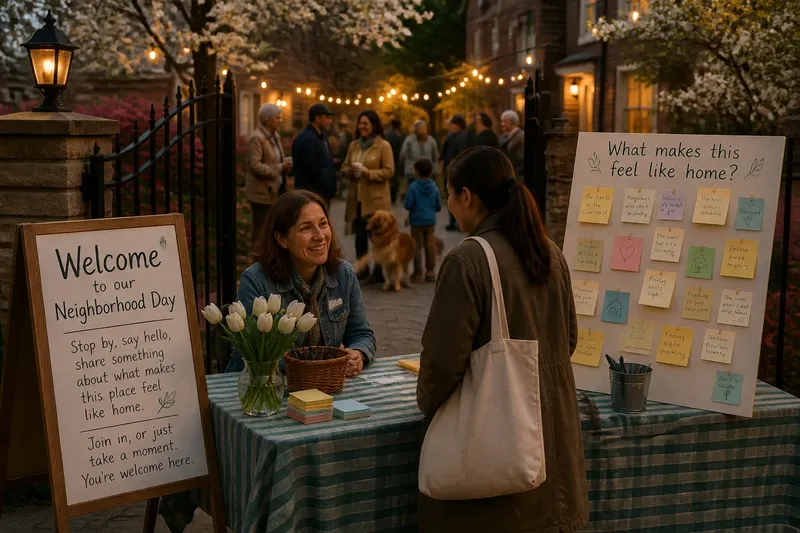
The organizers choose three elements to carry forward: hold the event on the first Saturday after the neighborhood spring cleanup, place a welcome table near the courtyard entrance, and invite residents to add notes to a display called “What makes this feel like home?” These are working choices, not laws. The date can shift if it conflicts with another local event, and residents can suggest a different use for the display.
They leave other details open. The gathering does not require a particular meal, theme, or activity. Residents can stop briefly, stay longer, or take part without speaking to a crowd. That keeps the custom from becoming a test of sociability, a test few people requested.
Repetition works best when its recognizable parts are easy to sustain. A familiar place, a dependable welcome, and a clear invitation can connect one year to the next. Changing details make room for local tastes.
Make participation visible without making it compulsory
On the chosen Saturday, the welcome table sits by the courtyard gate. A hand-lettered sign explains the gathering. The display has paper slips and pens, with a note that people may write, draw, or leave it blank. Residents take turns greeting arrivals, but nobody is expected to draw out a personal story.
Some residents write about the tree that shades the courtyard. Others mention a neighbor who brings in packages, a familiar sound from an open window, or someone who can recommend a repair shop nearby. The display makes visible how differently people experience one place. It gives newcomers a glimpse of what residents mean by “home” without asking them to adopt someone else’s account.
Imagine a new tenant, Mara, arriving after the gathering has started. She reads the sign and writes about the corner where she waits for her child after school. A neighbor recognizes the spot and points out a covered place to stand when it rains. Mara leaves with useful local knowledge, without being recruited into a committee or asked to address the group.
Small exchanges like this can give a recurring gathering meaning. The event does not need a dramatic highlight. A recognizable setting and more than one way to respond can make ordinary neighborhood knowledge easier to share.
Keep a short record of what should carry forward
After the event, one organizer writes a brief note for next year. It records the date, where the welcome table stood, which sign prompted questions, and what residents asked to change. It does not try to capture every conversation or rank the gathering’s success.
The group may save a few anonymous notes from the display, after asking participants whether that is acceptable. It treats them as prompts for a future invitation, not as a complete account of neighborhood opinion. A handful of comments can be evocative; they are not a vote.
A useful record can check:
- Check whether the stated purpose still describes why residents gather; if it does, keep it in the invitation, but if it does not, ask residents to revise it before planning.
- Check whether the chosen date conflicted with a local event or residents’ schedules; if it worked for the people organizers hoped to reach, keep the timing, but if it created a conflict, ask about another date.
- Check whether the welcome table was easy to find from the courtyard entrance; if arrivals found it readily, keep its location, but if people asked where to go, move it or add clearer signs.
- Check whether the sign explained the event and optional activities; if people understood how to join or pass, reuse its wording, but if they needed clarification, rewrite it in plainer language.
- Check whether the display allowed quiet participation without personal disclosure; if residents used it comfortably, keep that option, but if the prompt felt too personal, offer a more general question or an activity that needs no written response.
- Check which concerns remain unresolved; if they affect access or participation, assign a person to discuss them before repeating the event, but if they are preferences rather than barriers, record them for the next planning conversation.
The record supports continuity, not bureaucracy. If a detail no longer works, the next group can change it knowingly. If a useful practice is forgotten, the note can bring it back into view.
Let residents shape the custom beyond its organizers
By the next year, Maple Court’s gathering is recognizable. Residents still expect the welcome table and shared display. Another resident proposes a small map where people can mark places they use for everyday errands. The organizers add it without replacing the familiar elements.
This keeps the event from becoming the private property of its first organizers. A custom can have stewards without having owners. Stewards tend practical details and explain the history; other residents remain free to question, adapt, or decline them.
A neighborhood is not one audience with one schedule or one idea of welcome. Some residents work weekends. Some prefer not to share personal details. Others may be new, busy, or wary of an event that appears to have an inner circle. Flexible participation helps prevent a familiar ritual from becoming a boundary around who belongs.
What helps a neighborhood day become a custom?
How often should the gathering take place?
Choose a rhythm residents can remember and organizers can sustain. An annual date can hold a clear place on the calendar, while linking it to a familiar local occasion can make it easier to recall.
What should stay the same each year?
Keep the elements that help residents recognize the day and understand its purpose. A location, welcome, or shared ritual may be enough; elaborate programming is not required.
How can newcomers take part without feeling put on the spot?
Make the purpose visible and offer more than one way to participate, including brief or quiet involvement. Do not make introductions, public speaking, or personal disclosure the price of entry.
When should organizers change a familiar ritual?
Change it when the old form excludes people, no longer serves its purpose, or creates burdens residents do not want to carry. Explain the reason, then preserve any recognizable element that still connects one year to the next.
Tell a modest, accurate story about the day
Maple Court’s organizers do not claim that one gathering transformed the neighborhood. They describe a smaller sequence: residents wanted an easy way to recognize one another, chose a few repeatable features, and used the shared display to start conversations. The account leaves room for next year to differ.
That restraint helps future organizers. If the gathering is described as a triumph, they may feel pressure to reproduce an imagined high point. If it is described as a set of choices residents can revisit, they can keep what matters and discard what has become ceremony for its own sake.
An annual neighborhood day becomes a local custom when its repeated details help residents recognize both the gathering and its purpose. For Maple Court, the welcome table and display offer that recognition; another neighborhood may choose different details. Before inviting people back, organizers can state what they plan to keep, what they plan to change, and why the day still makes sense.